Funeral Services
July 5th, 2013 Posted in Family, Joe Becker, On the Internet | Comments Off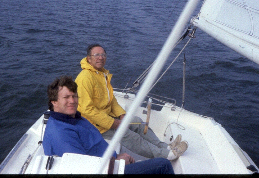
Kevin Meehan and Joe Becker
Since my last post my family and I have experienced deaths of two or our loved ones.
First, I lost my husband and best friend, Kevin John Meehan on June 16. He was also a friend to many at church and through sailing, and he will be sorely missed.
Then, on June 23 I lost my father, Joe A. Becker, about whom my most recent posts have been focused. At 95, he had outlived many of his contemporaries, but the sailing community remembered him and came out for his funeral service earlier this week.
I have family and friends who were unable to attend the services of one or the other and who would like to have access to the recordings, which were made by Boston Avenue United Methodist Church in Tulsa, Oklahoma. To make the recordings available through this site, I have uploaded the two files, which are in .mp3 format.
Click here to listen to the recordings:
For Kevin John Thomas Meehan, 1957-2013.
For Joseph Aloysius “Joe” Becker, Jr., 1918-2013.
Memorials for each of them are currently available for viewing at ninde.com, the website of Ninde Funeral Service in Tulsa.
Catalina 22 Championships – the Crew
June 12th, 2013 Posted in Family, Photographs | Comments Off
Joe Becker and crew John Smart with the C22 National Championship traveling trophy, 1976
My mother scanned some of these old sailing photos several years ago and I am glad to have them to share here.
The first is from 1976, with Joe Becker (skipper) and John Smart (crew) next to the 60-pound traveling trophy which was over five feet tall. The third member of the crew was Gerry Gavin of North Sails who had apparently returned to Wisconsin before this photo was taken. Joe and crew had finished first in the 1976 C22 Nationals in Seattle, Washington. John Smart continued to crew for Joe in local races, and when he crewed in Jackson, Mississippi for the 1977 C22 Nationals, I was the other crew member. The winner that year was Dick Durgin, a sailor from the local area. We finished second overall.

Lake Huntington, California, 1985, Joe Becker and crew, Bill Hall, with the entourage
In 1985, Dr. Bill Hall was Joe’s crew. When Joe was unable to explain being passed by competitor after competitor, Bill dove in to the lake to discover the cause of Luff Affair’s poor performance, and found that a piece of carpet had been stuck to the leading edge of the boat’s keel. The explanation was simple: the carpet was stuck as a result of a last-minute paint touch-up before Joe had lowered the retractable keel down onto the trailer and onto the protective scrap of carpet placed between the keel and the trailer’s keel-guide.
I can’t recall the name of Bill’s wife at the time, but the other two pictured along with Joe and Bill were my mother, Gerry Becker seated at the left, and my aunt, Sara Becker Coleman of Canoga Park, California, which was ironically very close to Catalina Yachts in Woodland Hills, California.
For the results of the 2013 Catalina 22 Nationals, and for a history of the Catalina 22, visit http://www.catalina22.org.
Catalina 22 National Championships
June 12th, 2013 Posted in Family, Joe Becker | Comments Off
Joe Becker with Luff Affair and the C22 Nationals trophy
The 40th Annual Catalina 22 National Championship Regatta is being held this week in Ft. Walton Beach, Florida. A trek to the various locations of this three or four day event was a standard summertime ritual for my father, Joe Becker, and for several of those years for my entire family as well.
In 1975 Joe selected a Catalina 22, sail number 4747, and travelled to Lake Ray Hubbard outside of Dallas, Texas, for the 3rd annual championship regatta. He won the championship that first year and then again the next year on Shilshole Bay in Seattle, Washington. This time, my mother and sisters and I made the trip, and along the way I sketched out a stylized “name” for the transom – “Luff Affair,” which was the creation of my mother, Gerry.
He didn’t win the event again after 1976, but he competed in about 24 of the regattas. With the help of the C22 National Sailing Association’s website and some of our family’s private archives of newspaper clippings and recorded race results, I have put together the beginnings of a record for Joe to see, and to share with any of his friends and supporters, especially any of the past crew that might want to see them.
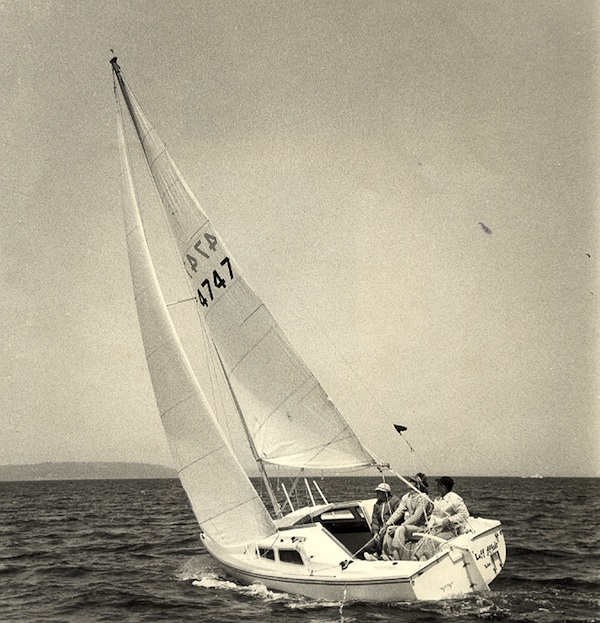
Catalina 22 #4747 on Puget Sound during the 1976 C22 Nationals, with crew John Smart and Gerry Gavin.
The list begins like this:
1973 Long Beach, California – won by Tom Winans
1974 San Francisco, California – won by Gene Carapetyan
1975 Lake Ray Hubbard, Dallas, Texas – won by Joe Becker with John Cameron and two other crew
1976 Shilshole Bay, Seattle, Washington – won by Joe Becker with John Smart and Gerry Gavin as crew (and I was asked to crew for Tom Winans, who finished third)
1977 Jackson, Mississippi – won by Dick Durgin. Joe finished 2nd with John Smart and who else as crew?
1978 Eagle Mountain Lake, Ft. Worth, Texas – won by Bill Culp. Joe was possibly 5th.
1979 Lake Lanier, Atlanta, Georgia – won by Beattie Purcell. I need to find Joe’s finishing position, but I can tell you that Kevin and I were the crew.
Through the years, many sailing friends served as Joe’s crew. I have some photos to share, but I need to find others. If you know of a former crew (or if you were one), please tell them about this little opportunity to reminiscence and share stories about our connections through the C22 sailing family.
Old Sailors Never Die…They Just Get a Little Dinghy
May 31st, 2013 Posted in Conversation, Family | 3 Comments »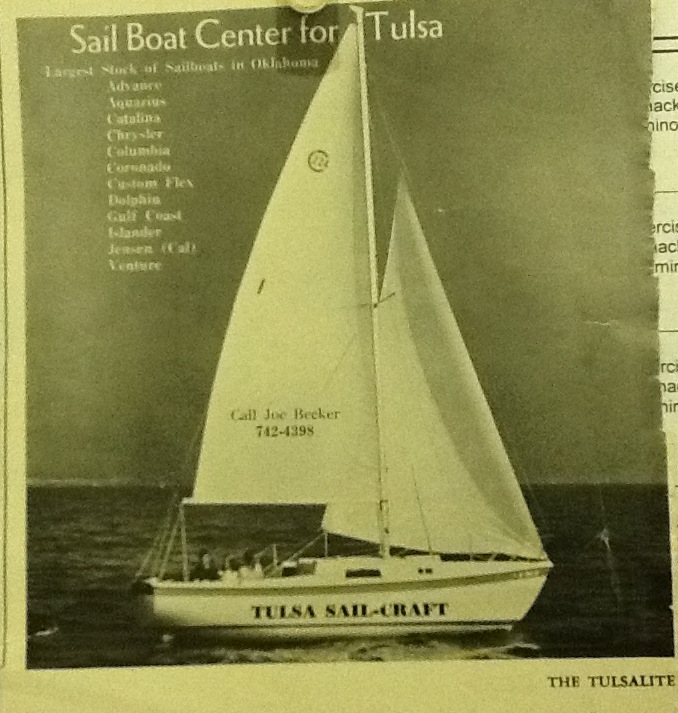
Tulsa Sail-Craft ad in The Tulsalite
Old Sailors Never Die…They Just Get a Little Dinghy – that was one of my Dad’s favorites, back when those sayings were popular. He wasn’t really a jokester, but he enjoyed lots of little things, like telling stories and hearing stories told about him – mostly sailing stories. His memory doesn’t help him recall everything lately, but he’s been comfortable and happy.
Sometimes he is concerned because he would like to solve some problem out there, but there isn’t much he can do now. He tries to work out how to find someplace to stay, or how he could make some money. Today he said something about trying to improve the wheelchair. I asked him whether he wasn’t the one who designed the centerboard lift system that the members used at Sequoyah Yacht Club to store their boats above the water (instead of having to pull them out after the weekly races), but he said that he doesn’t remember.
He developed a mast carrier for the Catalina 22, and we used to sell them at Tulsa Sail-Craft. With one device, which had a pair of pintles to hook onto the C-22’s gudgeons, he could not only carry the mast, but could lift the mast high enough that he had a good start on raising it the rest of the way by standing on the cabin. He called it his “six-foot friend.”
He designed some other sailing solutions like a way to determine the depth of the water at the boat ramp, and even submitted some to a national sailing magazine (probably Sailing World), which published at least two. He designed a keel guide for helping to load the retractable-keel Catalina 22s onto their trailers, and he loved to design mast-raising systems for larger boats.
I remember staying up late one night at the old “boat yard,” as he built some sturdy, wooden steps so that potential buyers could step up alongside a soon-to-be-displayed boat on a trailer – probably a Catalina 22. The Boat Show would be the next day and so when it was about time to head for home, he started designing and building those steps. I would probably have been too young to drive, and had tagged along with my dad to work that day. I was an unofficial helper, and he probably asked me to hold this, or hand him that, which I did, and he did the hard part. We were in the very small building which housed the “office” and “shop,” at the boat yard on Latimer Court, behind Burkhart’s Marine. Burkhart’s owners, Art and Ruth Burkhart Obermire, sold marine hardware and rented us the space in the back.
Tulsa Sail-Craft would have two more locations after, and had occupied at least one rental space and our backyard before this one, where my dad sold boats in the early 1970’s. My grandfather (and my sisters probably) helped sometimes, and there were a few paid employees, too. Dwayne Nelson told me that he had worked for TSC when it was on Latimer. We visited after the memorial service for his dad, Charlie Nelson, who had taught our sailing school later.
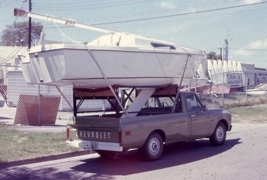
Actually, I had been on the payroll earlier, as well. My sister and I would assemble the sail rigs for the Dolphins that would arrive at our house by the dozen or so, fastening the sails to the spars, and then the spars to the masts, and adding the main sheet and halyard to each rig and binding the long rig together by a chain of slip knots. The photo that shows a newly-arrived Catalina 22 loaded on the back of a pickup truck, also shows some of the Dolphins leaning against Burkhart’s.
If I ask my dad about all of this tomorrow, though, I’m not sure he’ll feel like discussing it. He was feeling very tired tonight.